
The Communication Triangle
Who can hear whom, who can see whom, and the one loop that makes every module a routing problem.
Checked with game version 1.1.0
Every piece of information in Bombanana has exactly one way to travel. Learn the loop once and every module becomes a routing problem.
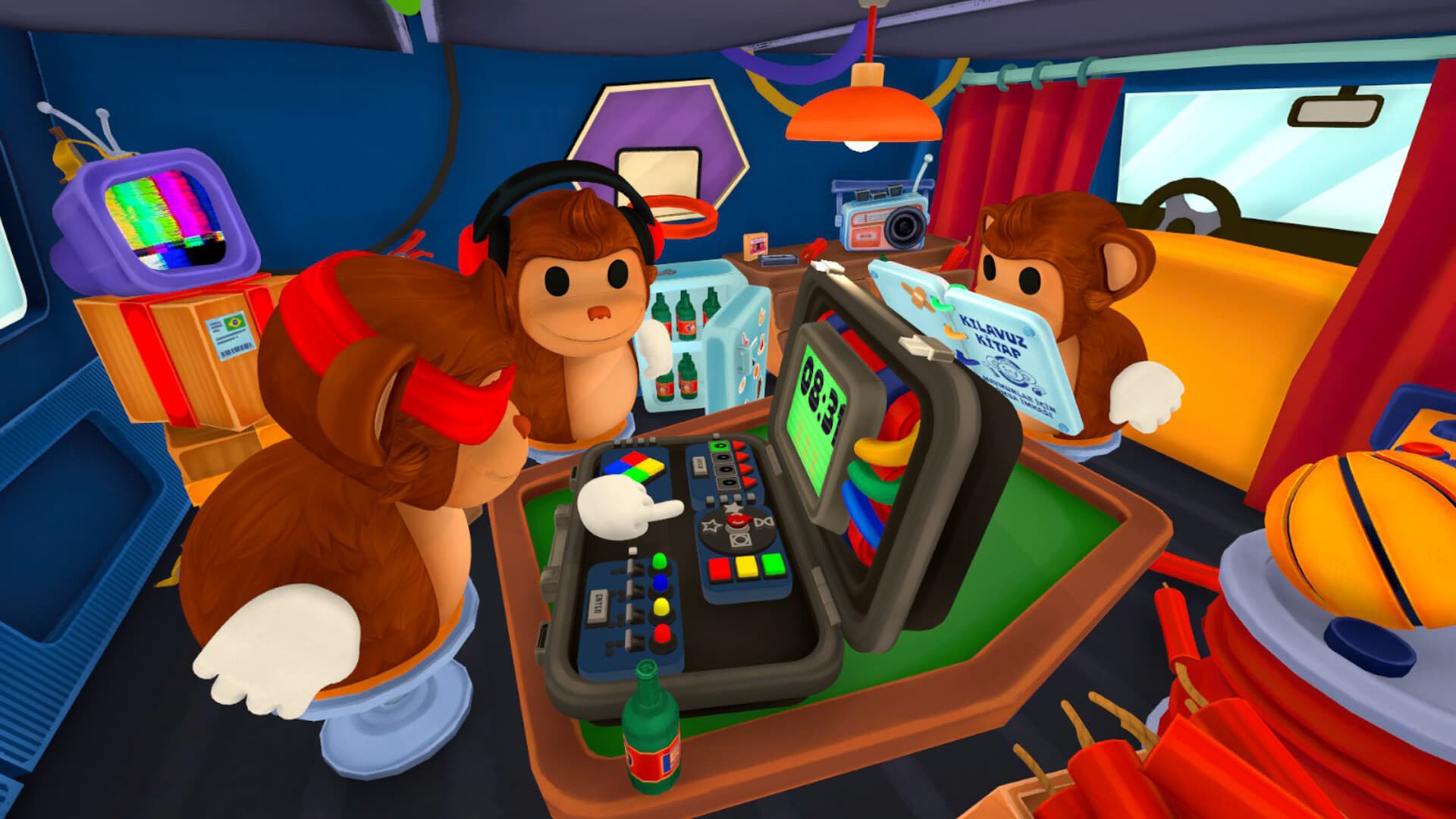
The loop
- The deaf player sees the bomb and says what is there.
- The mute player hears it, finds the rule in the manual and answers with a gesture.
- The deaf player sees the gesture and tells the blind player what to do, as a position.
- The blind player acts and says what they did. The mute player hears it and checks.
The blind player's voice reaches only the mute player. The mute player's gestures reach only the deaf player. The deaf player's voice reaches everyone. Plan around that: a question from the blind player takes two hops to be answered, so ask questions that a nod can answer.
Packets, not conversations
Call each module as one packet in a fixed order: module name, then the state the manual needs. "Cable: four cables, light blue, red green yellow blue." "Direction: number four, red." The mute player should never have to ask for a missing piece, because asking costs two hops.
Instructions to the blind player are positions, never colours, and always carry the module name: "Switch, two, down." A bare "two" is a strike waiting to happen.
Before the timer starts
- Agree gestures for yes, no, wait, "read it again", the numbers 1 to 9, and zero. The emote wheel and finger counts cover most of it.
- Agree a counting direction for every row of things: left to right, top to bottom, from the blind player's point of view.
- Decide who owns each Chaos element for the whole level, and the phrase for returning to the interrupted module ("back to Calculator").
- Decide who says "stop". It has to be the deaf player; nobody else is heard by the blind player.